
After a fantastic liftoff, the rocket disappeared into the sky. I quickly set down my camera and picked up the receiver. I caught a signal to the southeast, and hopped into the car with some friends to go chase it. Two hours of driving around did not yield a single signal, and the rocket was given up for lost. We had several ideas why the signal could not be picked up: The rocket could have come in ballistic and buried itself underground. The rocket could have landed in water (since it had rained a lot previous days and flooded parts of the fields) and shorted out or blocked signal. Or it could have landed behind some structure or in a valley or ditch. The battery was new and good, and taped in securely, so it is unlikely that it caused the loss of signal. And while I did tape around the entire transmitter with electrical tape, there is a possibility that ejection gases could have gotten to it and messed with the electronics.
Since the rocket did hold together and didn't do anything wild or unstable, it is safe to assume that it did go supersonic, maybe as fast as Mach 2. I'm hoping to try some even faster minimum diameter projects in the future. First I have to earn some money.
Showing posts with label High-Power Rocket. Show all posts
Showing posts with label High-Power Rocket. Show all posts
5/29/12
Successful Launch, Failed Recovery

5/18/12
Mach 2
One of my goals this summer is to break Mach 2. When I got back from school earlier this May, I started work on a new rocket that should be up to the job.
It's a 38mm minimum diameter rocket made of hand-laid fiberglass in my very own composites lab. Rocksim predicts a top speed of Mach 2.3 on a 6G Cesaroni J360.
It is an exercise in space/weight efficiency, construction techniques, and strength of materials.
 |
| I used the motor casing as a form and wrapped wax paper around it to protect it. |
 |
| Then I went around with liberal doses of epoxy resin. I used about 2 feet of cloth. |
 |
| This was the result after the wrapping. To prevent it from hardening into this bumpy matrix pattern, I wrapped a layer of wax paper around the entire thing. |
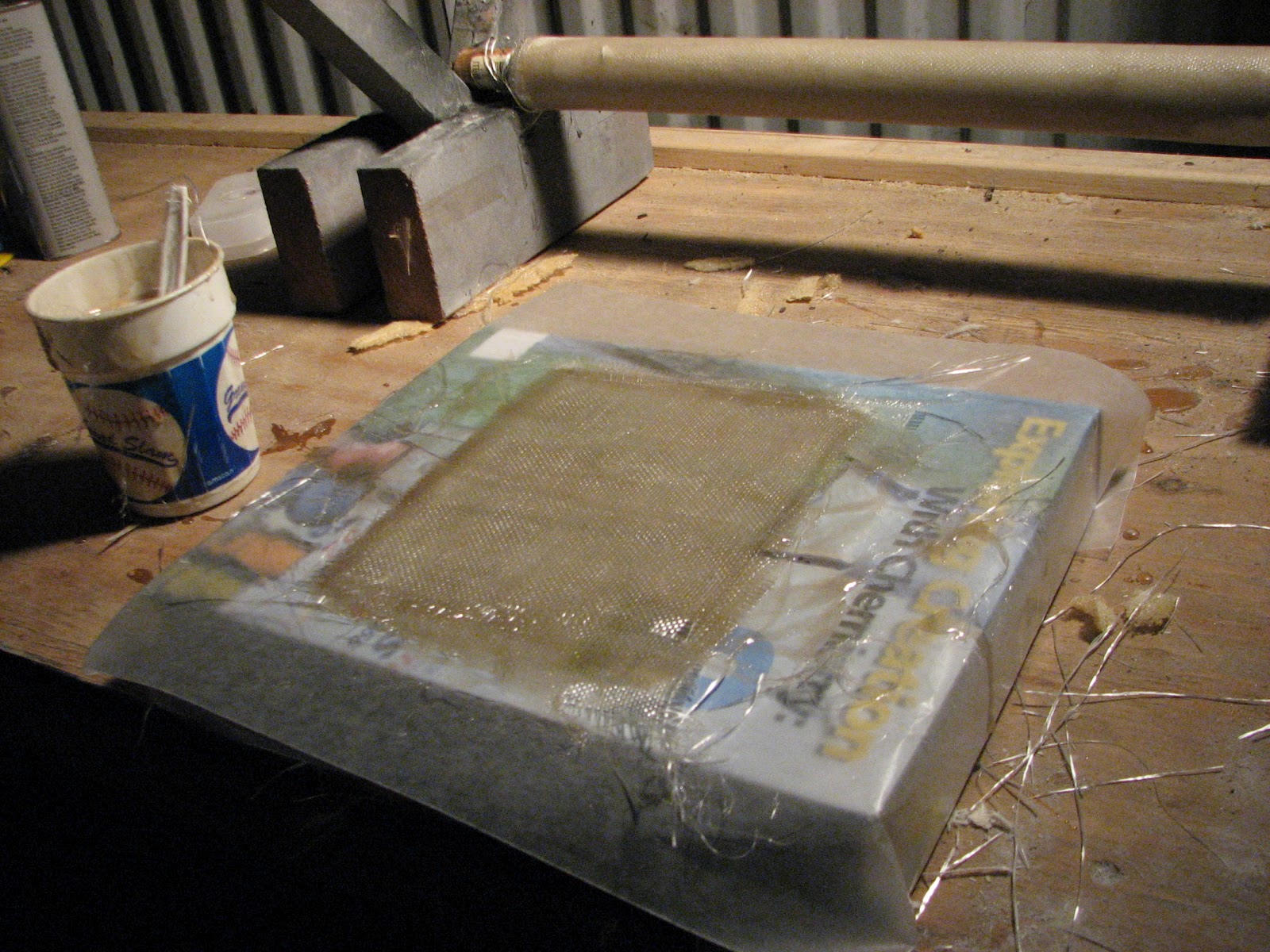 |
| For the fins I made a little fiberglass sheet with about 8 layers of cloth. |
 |
| I then covered it in wax paper and pressed it with some heavy books. |
 |
| (Such as an astrophysics text). |
 |
| Very happy with the result. Taped on RockSim templates. |
 |
| Cut them out with a jigsaw. |
 |
| Sanded them even, gave them double-wedge airfoils. |
 |
| Not much room for TTW fin attachment, but I did cut slots and but the fins up against the motor casing. |
 |
| Used lats of epoxy. |
 |
| A good view of the fillets. Used 60 minute epoxy mixed in fiberglass dust that I collected from sanding the fins. The fiberglass dust gives the epoxy more of a matrix, which increases the strength. |
 |
| Recovery is going to be a little tricky, but I've got an idea that uses Kevlar shock cord. I'm planning to use a blaze-orange nylon streamer and, of course, a rocket tracker. |
I'm tentatively planning on launching this June at Tripoli MN.
I am also determined to make it to either LDRS or BALLS this year, but I have to earn some money first. It'll be an interesting summer anyway.
8/2/11
Build Pictures for the 2-Stager!
I have made TONS of progress on my recent project since my last post. The exterior of the sustainer stage is finished, and the inside of the booster stage is finished. I have yet to put in the altimeter bay, recovery system and staging electronics housing on the sustainer, and still need to glass the booster airframe and paint it.
My work on the booster is rather unconventional. I cut out some strips of 1/4 inch plywood and glued them between the fore and aft centering rings. I then wrapped around the entire booster with plastic wrap and filled 'er up with expanding A-B foam epoxy.
I took this rocket to the county fair (it's my last year in 4H), and it got a purple ribbon. So I will be taking it to the MN State Fair this September, which means I will have to come up from college that weekend. I have a good reason to do so, however: If I participate in the State Fair this year, I am eligible to apply for a scholarship, so it is worth it.


7/19/11
Complex L2


I am planning to build a two stage level-2 high-power rocket. This will be the biggest project I have ever undertaken.
I also plan to use the sustainer stage to certify L2 this August.
7/9/11
Fail. Again.
I was able to get off work for this Saturday for this month's Tripoli MN high-power rocket launch. The plan was to try and certify level 2 again, since I failed my first attempt last month.
I'll cut right to the chase and tell you I failed once again.
I swore that my system was fool-proof. It was super simple: a large 10-lb rocket on a large sparky J-motor that would go to 2000' in altitude and land gently on the field under a 72-inch parachute. No dual deploy, no electronics, no rocket hunters, nothing fancy. Just the basics. What could possibly go wrong?
The parachute got stuck inside the rocket, that's what. It came out just fifty feet above the ground, giving us false hopes that the rocket would survive, and we thought it did. But a tent in front of my view blocked the fact that the rocket separated, and the rocket was rather damaged.
I'm not as disappointed as I could be, however. Because I can still continue to fly level-2, and with a 15% discount for certification attempts!
Here's the video:
8/13/10
Certification Attempt Tomorrow: Gulp.
Tomorrow is my one shot at certification until next year. I hope to use Stinger for my L1 cert on a Cesaroni I285. If I pass L1, I'm hoping to try L2 on a J285. If everything goes correctly, I should go from level 0 to level 2 in just one day! If I pass, I'll come back next year with an L motor!
I've been doing a lot of ground testing, since I've never tried altimeter based ejection charges before. Today I put one gram of black powder in the ejection charge, used a longer shock cord, and a lot more wadding. I think that one gram was just a bit too weak, and somehow the parachute still got a wee bit singed. What I need is Nomex cloth. Too bad I don't have any.
I HOPE I PASS!!!
You can expect a very peppy launch report tomorrow.
7/23/10

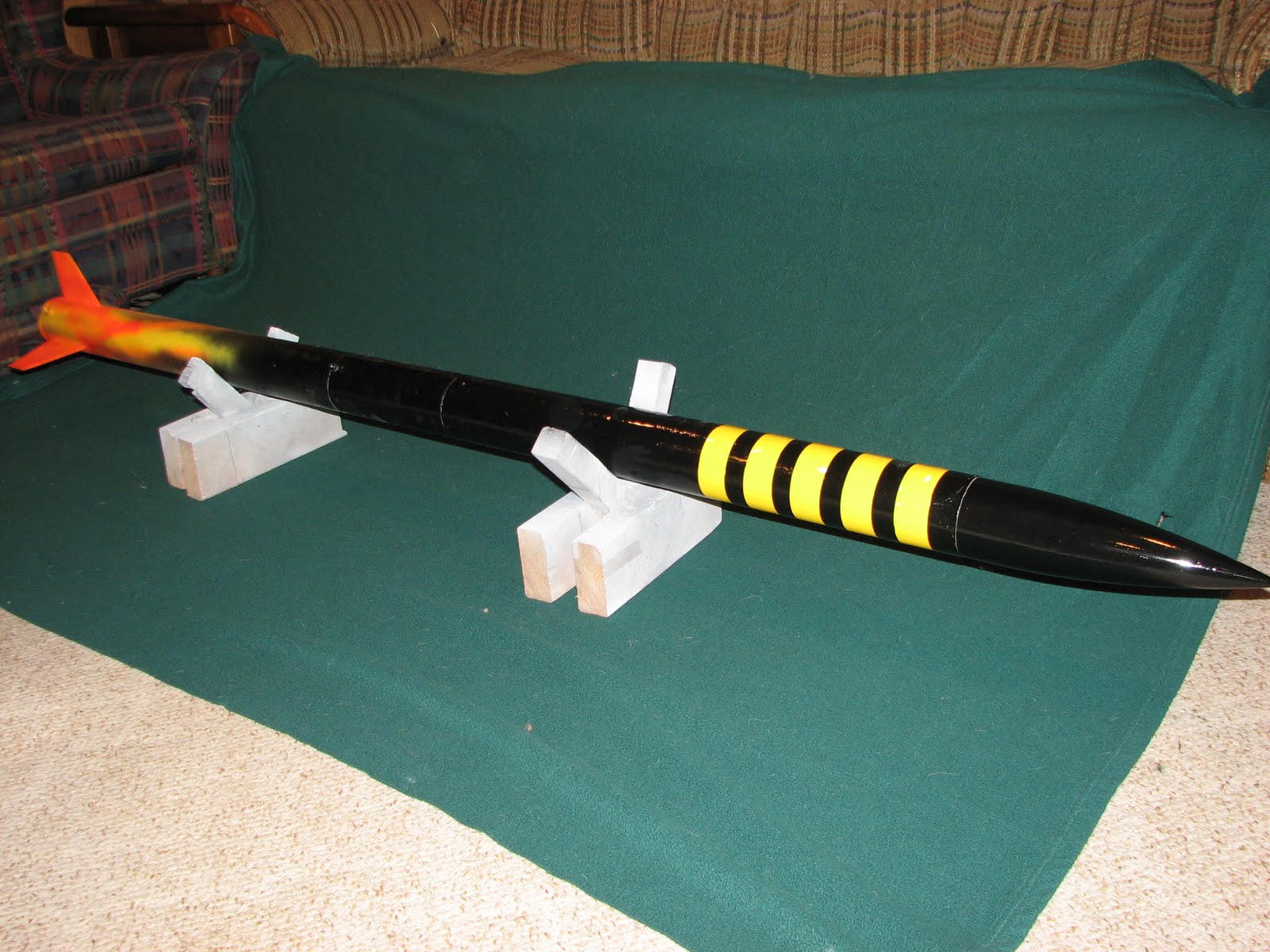

7/17/10
Stinger

This is it! The picture above is the actual rocket, but the paint scheme is just a concept. I edited the picture on the computer.
I've never actually done a flame job before, but it seemed like it would be a fun thing to try.
The rocket is almost done. I just have to fix the electronics bay (that I stupidly broke), and finish the paint job.
I'm hoping to get level 1 and level 2 certified on this rocket, all in one day. Level 1 will be on an I285 and level 2 will be on a J285. It should do about 5500 feet on the J!
I'm so excited!!!
7/1/10
Beginning Work on Construction of Certification Rocket!
Simple.
I am hoping to get certified with as little difficulty as possible, that's why my certification rocket is just a basic 3FNC rocket.
So far I have glassed the air frame, cut out the fins and centering rings, constructed and glassed the motor mount, purchased the motor case and spacers, ordered the tube couplers, nose cone, parachute and rail buttons, and generally have just been having a great time.

I'm a bit frustrated because one of my centering rings just disappeared and I've been looking everywhere for it. Can't find it.

I need to order a good altimeter for deploying the chutes. I'm thinking about ordering the Parrot Featherweight, but I'm still deciding. What altimeters do my rocketeer readers use?
6/22/10
What I've Been Doing Lately
Not rocketry per se, but I've been working a lot lately to earn money for rocketry. Very soon I will purchase all the supplies I need to build my certification rocket!
Here's a video I made (a commercial, actually) that shows a little of what I've been doing lately:
As for the rocket I'm planning to build, I'm trying to save money by building a rocket that could be used to certify on both level 1 and level 2. I also bought a 38mm 6-grain Cesaroni casing that can be used with both I and J motors, so I won't have to buy two casings for both certifications. It's a basic 3FNC (three fins and a nose cone) design. I'm taking the KISS approach for once in my life (keep it simple, stupid!).

Yeah. Life's been busy.
5/24/09
Largest Amateur Rocket in MN!
I just happened to turn on my computer and check my email for the first time in six days yesterday, and got the news that Tripoli MN was going to have a research launch that same afternoon. The plan was to launch Big Yeller, a twenty foot tall rocket weighing 180 lbs, the largest amateur rocket flown in Minnesota! Of course I couldn't miss this event.
Above, the team is arming the altimeters just before launch.

A lot of people rushed off after the launch, but I came down to help recover the rocket. They were glad of an extra hand, because it was a bulky thing to lug around in the cornfield.

I took a picture of the aft rail button (the part that holds the rocket on the pad). It sustained some damage that looked like it had gotten stuck on the launch pad. Apparently this drag at liftoff nearly halved the altitude.

3/16/09
Announcing a New 2-stager!

"Untitled"
Length: 48 in
Diameter: 3 in
Payload: camera, altimeter
Max. altitude: ~3,000 ft
Max velocity: mach 0.5
Max acceleration: 350 ft/s/s
No. stages: 2
MMT: 29mm-29mm
Intended motors: G64 to F40 or G64
I'm VERY excited about this one. It's my first composite motor staging attempt, and (once again) I'm being pretty ambitious. This will also be the first rocket to use the altimeter to deploy the chute, and I haven't the faintest idea how that works.
I'm trying to do a SUPER job on this one, spending extra time shaping airfoils, glassing airframes, polishing, and fitting together every piece. I love engineering!

By the way, as usual, I can't think of a name. So if you have any ideas, I'd appreciate it!
1/11/09
High-5 Taking Shape


The past few days I've been working on my big project, High-5. I'm hoping to get it finished by this summer, and perhaps I'll even be able to get junior level-1 certified on it!
It's a fairly complex design, and employs such gizmos as airstart electronics (already installed) and altimeter-activated parachute charges (which I'm still figuring out). I like to set my goals high, because I have to exert more of myself to attain them, and as a result get stronger. (Like a muscle).
Subscribe to:
Posts (Atom)
