- Try to design a rocket on RockSim to break 100,000 ft using K motors
- Make up polynomials and then factor them
- Eat a bowl of cereal
- Try to find shortcuts to evaluate the nth derivative of a function
- Make popcorn
- Watch obscure movies
- Think about the Universe and wonder if it has a limit, then muse about the space-time continuum and wonder if what theoretical physicists say is true.
- Create short films
- Create computer programs that will help me win play money in physics class
- Eat a bowl of cereal
- Read Spacecraft-Environment Interactions by Daniel E. Hastings
- Write blog posts about what I do when I'm bored
- Organize my room by rocket construction: my desk (where I design them), my supplies and materials shelf (coming soon! Right now everything's just piled up), my workbench, and finally my display rack (coming soon! Right now all my rockets are just piled up)
- Buy hundreds of notebooks at Wal-Mart in August when they're only $0.05 then sell them at a garage sale in the spring for $0.10.
- Read the dictionary
- Write in my Aerospace Research Journal. Usually when I'm bored, its just random stuff I pull off the Internet. But when I'm not bored, I use the journal for some pretty exciting projects!
- Use RockSim to design a rocket using no more than a D motor to break the speed of sound
- Eat a bowl of cereal
- Go out into the garden and sit on our 200 lb pumpkin to think
- Homework
- Read Rocket Propulsion Elements by George P. Sutton. I love this book!
- Wonder why I have no money, then look around my room at all the rocket gear, and then remember why
- Read about unsolved math problems
- Think about college and wonder what school I will end up attending
- Read the Bible (the best thing to do when you're bored!)
- 20 pushups!
- Nap
- Come up with ideas for new research projects that I could start once I'm un-bored
- Procrastinate from homework
- Go out to field 12 and dream about flying rockets
- Wonder why I have no rocket materials, and then remember I have no money
- Write a novel in 30 days
- Watch ingenius YouTube videos
- Sell collectible Avon bottles on eBay
- Eat another bowl of cereal
- Read The Handbook of Model Rocketry by G. Harry Stine. Nope. I haven't outgrown it yet and never will. I've read some of the most basic sections over and over and I can still get something out of it
- Direct a short film
- Look at the world map and wonder what places like Uchquduq and Bora Bora are like
- Write about reasons why the Big Bang Theory really should be considered a hypothesis because of all the vague evidence interpretted by biased scientists (actually, all scientists are biased, even when they try not to be), and then wonder why everyone has just accepted the hypothesis as fact without even exploring the facts for themselves?
- Apply to MIT and Embry-Riddle, just for kicks
- Do self-study on amateur radio to hopefully earn my license soon
- Draw cartoons (I'm toying with the idea of coming out with a new strip)
- Write a program that does linear programming which turned out to be pretty useless but I learned a lot
- Make lists. All kinds of lists. Anywhere from to-do lists to rocket supplies lists to Christmas gift ideas lists to lists of subjects I want to learn more about
- Join a rocket club at school where we launch eggs
- Start another money-making enterprise
- Knit a scarf with tassles
- Go through things in my "special box"
- Take a ten-mile bike hike
- Write in my journal about how bored I am
10/9/09
50 Things I Do When I'm Bored

10/4/09
Some Math Jokes

What does a college freshman who failed his first calculus test have in common with a college freshmen who got a speeding ticket going 60mph in a 30mph zone?
Neither student knew the limits.

10/3/09
College
College.
The very word stirs two coexisting sentiments inside me.
The very word stirs two coexisting sentiments inside me.
The prospect excites me: to go out into the world to accomplish great and adventurous feats, to know a new life away from everything I've ever known...
And this leads directly into my other view, a seemingly contradictory state of inward compulsion, diametrically opposed to the aforementioned ideology. A myriad of fears overwhelm me concerning many aspects of college: people, finances, family withdrawal, rigorous acadamia; the list goes on.
Amid the maelstrom of fears and excitement, there is a constant in my function of emotion: my hope is built on nothing less than Jesus' blood and righteousness.
9/29/09
Optimum Mass Research Project
In between AP calculus, AP English 12 and Honors Physics, I'm working on a research project. The official title is "Optimum Mass of a Small Rocket Propelled Vehicle."
The basic premise of the research is to find the factors that determine the optimum mass of a model rocket. Does it occur when the maximum momentum is at motor burnout, or maximum kinetic energy?
The idea of optimum mass is to find the mass of a rocket that will yield the highest flight. You can't throw a bowling ball as high as a basketball, but you can throw the basketball a lot higher than a beach ball. So for any given shape, there is a mass that is ideal for a given impulse. (Of course, on the moon the optimum mass would always be zero, because there is no atmosphere to slow the rocket down, so you want it to be as light as possible).
My idea was to fly a rocket multiple times with all variables held constant save its mass. I built a small ballast compartment to fly different amounts of modelling clay. The next step wasto measure the altitude the rocket attains using two theodolites. I was hoping to see some correllation between mass and altitude, then determine whether the optimum mass was determined by maximum momentum at burnout or maximum kinetic energy at burnout.
There was a problem. I discovered that Optimum Mass can lead to Lost Rockets. Especially during September/October when the corn stalks are twelve feet tall.
I was hoping to finish this project and send it to New Jersey by October 1st for a science competition. But all that changed when I watched my little orange rocket drift over the horizon, never to be seen again.
I am still going to finish this research project, even though I missed the deadline for the competition. Maybe I'll enter it in some other competition or science fair.
P.S.
(For the scientists on my blog): I think that it might be possible to use logic to solve this hypothesis. The equation for momentum is given byp = mv
where p is the momentum, m is the mass of the object and v is the velocity of the object. The equation for kinetic energy is given by
E = 1/2(mv^2)
In the first equation, momentum rises with velocity. In the second equation, kinetic energy rises with the square of the velocity, meaning that when you double the velocity, it will take four times the energy to cancel the forward energy.
This is key: the drag equation also rises with the square of the velocity.
D = 1/2(rho*Cd*v^2*A)
where D is the drag force, rho describes the atmospheric conditions, Cd is a coefficient that sums up the complex dependencies, v is the velocity, and A is the fronal area of the rocket. Doesn't this equation look astoundingly similar to the equation for kinetic energy?
Is any of this making sense? I haven't exactly figured it all out yet, but when I do, I'll post my whole research report.
Happy Rocketeering!
9/16/09
Out-of-Context Shaffer Quotes
I recently started a new blog compiling some of the oddest, funniest, randomest, or goofiest quotes from my Honors Physics teacher Mr. Shaffer. He really means it when he says:
"I get to be a dork all day, and I get paid to do it!"
He really loves his job, as is evident in his teaching. I'm really enjoying his class, more than any I've taken at public school yet!
http://shafferquotes.blogspot.com
9/10/09
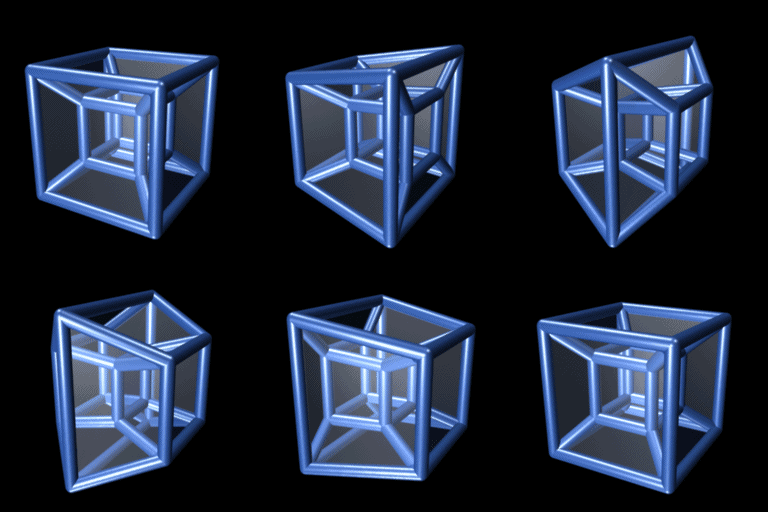
4D Tesseract
This isn't related to aerospace per se, but I've been into quantum physics off and on, and things like this fascinate me. This is supposed to be a "shadow" of a four dimensional object. If 3D objects casts 2D shadows, then it makes sense that 4D objects would cast 3D shadows. Now, it's important to realize that it is humanly impossible to visualize the fourth spatial dimension, but mathematics and computers can sometimes lend a helping hand in conceptualizing this.
9/7/09
Another Ribbon to Put on My Wall

My project on multi-staging techniques took an Award of Excellence (purple award) at the 4-H State Fair encampment this year. This project has been an incredible learning experience, complete with failures and successes. Soon I would like to move on from 4-H and enter other kinds of competitions and science fairs.
School has started today, and I'm taking some foundational courses essential to rocket science like calculus and physics. It's looking to be a great school year!
Subscribe to:
Posts (Atom)
