I just want to say, the higher the barrier, the epic-er the win. Or at least, the stronger you get.
Based on the early deployment of our payload, we are being required by NASA to conduct another test launch. No big deal.
Anyway, I am going to have no life outside of USLI and the occasional studying for the next... for a while.
Showing posts with label payload. Show all posts
Showing posts with label payload. Show all posts
4/4/12
USLI -- Interesting Developments

3/31/12
USLI -- Payload Electrical Fire!
We tried our first tethered test flight today... ended in disaster. But we learned a lot, and as far as we can tell none of the components are fried.
1/26/12
USLI -- Critical Design Review
We just put the finishing touches on our Critical Design Review report and PowerPoint presentation! Hilarious fact: the documents finished uploading to our website just three minutes before they were due.
But we put a lot into it, and if you're interested you should go check it out on our website: ISU-USLI.com
Within a week we will be ordering supplies and start assembling our payload and launch vehicle!
I was up until 6:00 am the other night working on this:
10/19/11
University Student Launch Initiative -- We Made It Again!
Our proposal was accepted, so Iowa State is now one of 42 universities competing in USLI.
The University Student Launch Initiative (USLI) is a NASA competition for universities across the country to design, build and launch a high-power rocket to an altitude of 5280 feet (1 mile). The rocket is designed to carry a scientific or engineering payload of the team's own creation. The launch is down in Huntsville Alabama near the Marshall Space Flight Center every April. Throughout the school year each team must submit four reports; the initial proposal, the preliminary design review (PDR), the critical design review (CDR), the flight readiness review (FRR) and finally the post-launch assessment review (PLAR). Other requirements are to create and up-keep a team website, and to conduct educational outreach activities on space and rocketry, or other scientific or engineering related disciplines.
Last year I signed on to the project as an exciting activity for my freshman year at Iowa State. It was such a good experience that this year I am co-leading the project.
We began meeting in early September to discuss what the project was going to be about this year. The payload concept had to be decided first, because it would dictate what sort of launch vehicle would be able to take it to a mile. There were many concepts proposed, including the following:
- Self-retrieving rocket (almost a joke, really)
- Load cells on fins/other protrusions to measure drag
- Deploy a rover on landing (similar to Arizona last year)
- Reconnaissance controlled descent vehicle
Somewhere along the line, somebody suggested powering the helicopter and going for a full-fledged UAV. This suggestion was initially met with some skepticism, since it would greatly magnify the complexity of the system.
Our current plan is to go for a quadcopter system, with hinges on the four deployment arms so that the payload can fit snugly into the rocket body. The nose cone will be part of the payload; a clear plastic hemispherical dome. The camera will be on a pan and tilt system using a motor and servo, and will transmit live HD video to a ground tracking station.
One of the benefits of this option is that the user can keep an eye in the sky for as long as the battery will last, which would be much longer than the time it would take for the payload to fall, retarded only by the free-spinning helicopter blades. This extra time-aloft increases the return on the significant cost of rocket-assisted deployment.
The launch vehicle concept is currently to construct it from fiberglass with a 7.7 inch outer diameter. The motor we currently plan to use is a Cesaroni L1115, which would take a 10-lb payload approximately 5500 feet. It's always good to design the rocket to fly higher than it's supposed to, because the rocket tends to be heavier than RockSim predicts and have a higher drag coefficient than RockSim predicts. Also, after the test launch in mid-February, if it is determined that the rocket will fly too high, additional mass can be added to bring the altitude down to the desired level.
One concept for the launch vehicle is to use air-brakes to keep the rocket from going over a mile. Judging from success rates of attempts in the past, this would be a very challenging design feature to implement. We're currently exploring the feasibility of this option.
We are all very excited about this project. I think we have a good plan, and a lot of good, fresh ideas. The team of roughly 12-15 students has a nice variety of skills, majors, experience, etc.
More updates will follow regularly. When the team website is up and running I will post a link. When we begin work on the project I will also post YouTube videos.
6/27/11
Arduino
Got an Arduino for my birthday, and I'm sooooo excited!
Okay, so you're probably thinking "What the heck is an... arr.. arr... thing?" Well, I'll tell you: It's an open source electronics prototyping platform, so I can make my own rocket payloads and robots and whatever else strikes my fancy.
We used an Arduino last semester for our USLI payload at Iowa State University. We started out using a PIC, which is similar but way more complicated. So we switched over to Arduino and the project moved along five times faster.
I'm looking forward to all of the different projects that will come of this. My first project will probably be a very simple robot, so stay tuned for that!

4/12/11
Structure of the Payload Complete, Programming Complete, Leaving Tomorrow
The payload is finished. The electronics are all soldered down. The program that runs it all has been completed in its first revision. The rocket has been painted snazzily. The only downside to this progress is that we worked until one in the morning, and I had a diff eq quiz at eight in the morning. SO... I took a three hour nap between 1:30 and 4:30, woke up and studied solid until now.
I brought some radio control equipment to try doing some drop tests in the Howe Hall atrium, but the only thing we learned from our one drop test is that we need a bigger parachute. It came down hard and fast, and broke off one of the freshly epoxied pieces. Easily mended though.
I'm not sure we'll be able to get much done today, however, because tonight the ISSS club is hosting a "Yuri's Night" party, a celebration of 50 years of human space travel, and everyone is going to be involved in hosting this. I might sneak in a few moments to put on the finishing touches though.


There will hopefully be live streaming of the USLI event on NASA TV this Saturday, so stay tuned for that. I'll post a link.
4/11/11
Payload Taking Shape
The CDV is starting to come together. I've been working on some of the functionality of the design, and composed this drawing:

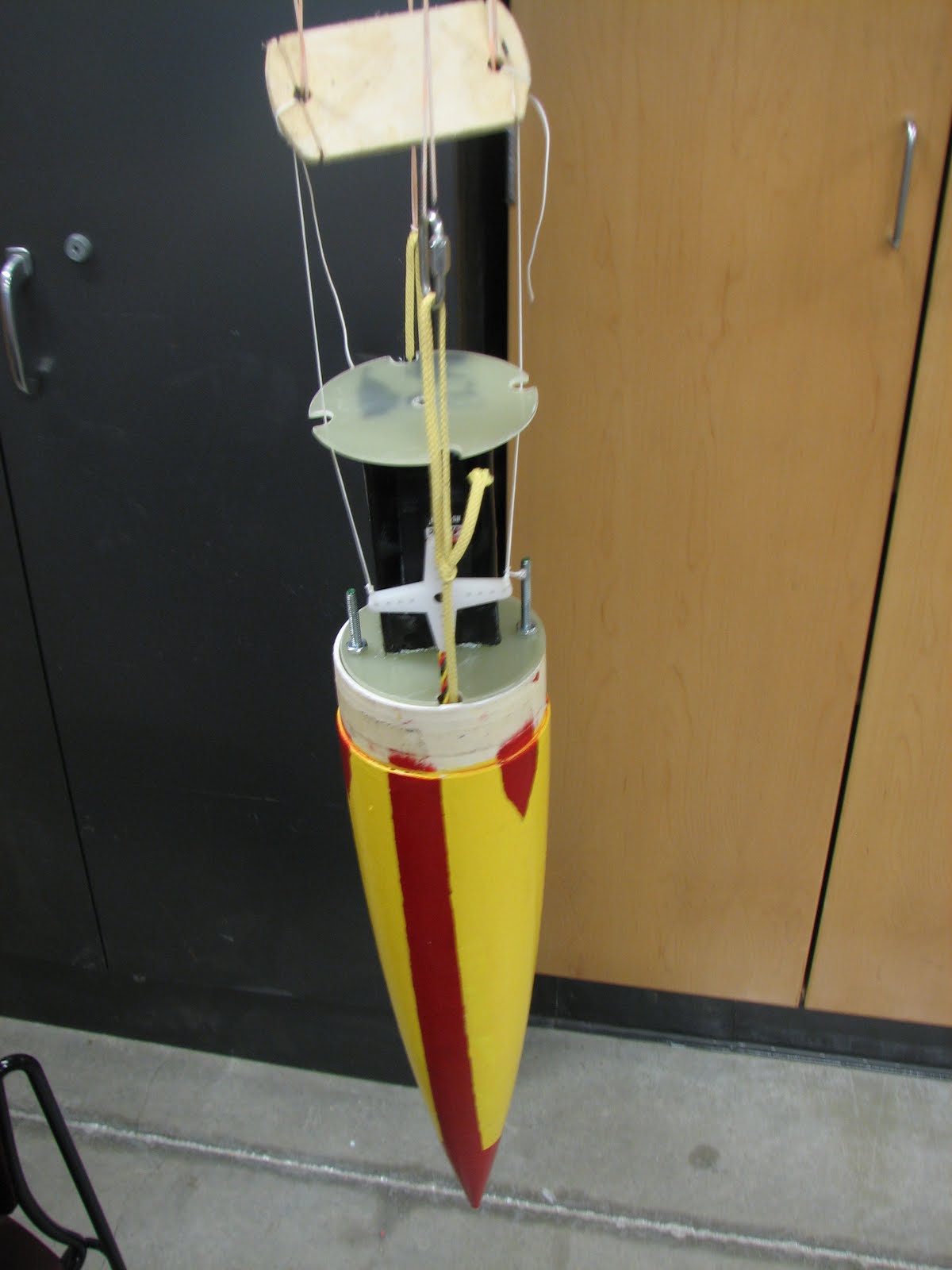
Here's a photo of the nosecone with the servo resting on top:

In addition to working on the structure of the payload, we continued to work on the programming of the microcontroller unit. We also started soldering the board together more permanently.
Sadly, we lost a chip. It was a gyro, that measured the angular speed. It must have gotten dropped in the lab somewhere. At least it wasn't the most vital chip, like the GPS unit. We could probably get by without it, because we didn't even write it into the code.
We have only today and tomorrow to get this thing finished.
Subscribe to:
Posts (Atom)
